Paths to God & The Way

See the source image

In The Way, Tom Avery recently lost his son, Daniel, due to a storm while he was making a pilgrimage on the Camino de Santiago. After deep remorse Tom decided that he would walk the Camino de Santiago and spread Daniel’s ashes along the trial. Along the way Tom meets three important people: Joost, Sarah, and Jack. The one that stands out the most to me is Jack. Tom, Joost, and Sarah meet Jack in a random open field as he was kicking the ground due to the immense pressure on him to overcome his writer’s block. Originally the writer’s block is the reason Jack took up this pilgrimage, to clear his head and get some ideas flowing, but by the end of the movie all the characters realize that their reasoning for walking the Camino de Santiago were wrong all along.

Through the movie, Jack’s journey portrays multiple paths to God according to Ignatian Spirituality that all connect together. One being the path of exploration. Jack started his journey all the way from Paris, France and all throughout the journey Jack was searching for something to kick start his writing. Something spiritual, motivating, or anything that he could make a book out of. That was the main reason for his pilgrimage at the time. But Jack didn’t know what he believed it and that’s why his exploration was so hard. For about 3 months Jack was searching, until Tom, Joost, and Sarah met him in a field. The first meeting between the 4, Jack’s mind is all over the place and is lost trying to make sense of every little twist and turn on the road. Until Sarah tells him “Maybe a dog fight near a cheese farm is simply a dog fight near a cheese farm.” This helps Jack calm down and not try to make a metaphor out of everything he sees on the road. This helps Jack’s path of exploration by getting his mind on the right path and not spiraling out of control like when they first met. Jack’s exploration led him to putting Tom’s story on paper and having much stronger faith and relationship in and with God that will be discussed shortly.

The second path that Jack’s journey embodies is the path of independence. Before Jack met the other 3, he was traveling alone from Paris to accomplish something that had nothing to do with God. He was ignoring his editors and later told the group that he hasn’t step foot in a church for a while. Jack is too caught up in his professional life that he barley had time to devout to God. He has an independent mindset and even describes a true pilgrim experience as someone who “walks with nothing…, lives of the land…, accepts the kindness presented to him, and carries his goods on his back.” What Jack doesn’t notice is that his time on the pilgrimage which was meant for him to overcome his writers block, slowly brought him back to the Lord which portrays his path of return.

Jack was lost, searching, and trying to do everything on his own until he had a rejuvenating experience on his path of return. Throughout the story Jack grew in himself and with the Lord. His path of return started ever since he met Tom, Joost, and Sarah and ended when he finally took the step into the cathedral of Santiago de Compostela. Jack is amazed at the beautiful interior of the cathedral and is overcome with a feeling of consolation. He is seen crying and praying to the Lord as he finally realizes why he was on the this journey. His journey through the Camino de Santiago reignited his faith in God and towards the end it seemed like his book did not even matter, all of his focus was on his rekindled relationship with God.

ASL Extra Credit – St. Nick’s Men’s Shelter

On March 9th 2020 I worked with Campus Ministry and a couple other volunteers to conduct a night at the St. Nick’s Men Shelter. The shelter is not too far from St. John’s (on Parson’s Blvd. to be exact) and is very convenient for St. John’s students so I decided to offer my time to help out. Initially when I got to the shelter the volunteers and I started to set up the tables and start to cook dinner. It was fun getting to know other students that I’ve never seen before and learning about them and their experience at St. John’s. I’ve realized that you can grow great connections with people from volunteering and working together for the benefit of others.

Once the men arrived they got situated in their rooms and came out to the dining room to eat with us. We all ate the meal we prepared and it felt like a family coming together for dinner even though I had just met all these new faces. Getting to know the men was a very redeeming experience. Learning about them, their background, and struggles made it a very humbling experience for me by making me more thankful for what I have because I learned everything could be taken from you in a heartbeat. They shared stories from their past that were genuinely interesting. One man has traveled 35 states and had it all going from him until he had an experience that changed his life and led him to be homeless. But still through it all he has remained positive with a strong sense of faith. He taught us a lot just about life and it taught me that you can learn a lot from anyone, even the homeless. These men were completely normal fun people to be around. All people have human dignity and when the poor and homeless are treated unjust it makes me wonder why, because they are exactly like us and if you’d get the chance to know them you would definitely agree with me.

After dinner the volunteers and I cleaned up and offered the men some coffee and desserts. They were so thankful and kind to us, but most importantly we were thankful to them for the experience we had with them. This night was time well spent with the men and my peers. I really enjoyed volunteering and I would defintley consider more students to do so. The humbling experience and life lessons will stick with me for a life time.

Martin’s 6 paths to God- Playlist

The Path of Belief

“Famous For (I Believe)”- Tauren Wells Martin’s Path of Belief is based on someone who always had God as a part of their life and may have been born into a religious family. Their faith has been strong and guides them through their life. In “Famous For (I Believe)” by Tauren Wells he sings about how he has “no doubt” in God and asking God to guide him through the fires of hell and all the negative things in the world. I can tell the artist had a strong religious background with strong faith.

The Path of Independence

“I’ll Give Thanks”- Housefires Martin’s Path of Independence is based on a person who separated themselves from the church because maybe they find church meaningless or for other personal reasons. But at the same time they still believe in God and find solace in what they learned as children. “I’ll Give Thanks” by Housefires is a song about needing nothing else but God. Housefires knows that they are not perfect, and asks God for his mercy.

The Path of Disbelief

“Mama, I Don’t Believe” – The Avett Brothers The Path of Disbelief is based on someone who does not belief in the existence of God. They constantly are trying to challenge believers and rejecting the possibility of God’s activity. The way I interpret it, in “Mama, I Don’t Believe” the Avett Brothers are singing about being tired of believing in something that we are told to be patient for, possibly heaven. The Avett Brothers also are done believing because of lives being stripped away from people in a instant.

The Path of Return

“Rescue Story” – Zach Williams Martin’s Path of Return is based on someone who began his or her life in a religious family but eventually drifted away from the church. This person’s faith remained distant but found religion intriguing. Questions arise and they return to their religious background being committed to learn. In “Rescue Story”, Zach Williams had nothing and constantly ran away from God, but God was always there for him and welcomed him back with open arms. Williams realized God was the one who was rescuing and fighting his battles for him when Williams didn’t notice.

The Path of Exploration

“I Still Haven’t Found What I’m Looking For” – U2 This particular path described by Martin is a common path taken by curious people. This path is based off of people that are searching for a religion that fits them by different conversations and experiences. In “I Still Haven’t Found What I’m Looking For”, U2 is searching through mountains, cities, and fields for someone or something. You can interpret this as religion as U2 haven’t found the correct religion that fits them personally.

The Path of Confusion

“Doing It Wrong” – Drake This path is one that many may experience and crosses all the other points at some point. People who are on this path are generally confused in what to believe and how to believe. Sometimes they find it easy to believe and pray to God and sometimes they find it very hard. They haven’t fallen away completely but they aren’t connected. For people of this path finding God is a mystery, a worry, or a problem. In Drake’s song “Doing It Wrong”, he is in a very confused relationship with a women and he thinks something is missing that cannot be replaced. He believes he needs something different and sometimes finds it easy and sometimes hard to love her. What he doesn’t know is that she loves him back and is indeed right for him.

The Cross and Lynching Tree

See the source image

The Bible teaches us that all men and women are created in the image and likeness of God. Not once does the Bible exclude certain races or ethnicities regarding this topic. To God we are all the same in his eyes. But even with that being in the first chapter of the Bible, immense racism has been shown by white Christian men throughout history. James H. Cone is trying to portray, in “The Cross and Lynching Tree” on page 48 ,that Jesus and the African Americans that were lynched are no different from each other. They were both killed in a terrible way because they were different, and Cone sees Jesus in the lynched black men. Personally, I see this as an extremely important subject and in order to become closer to God we must look at the darker times in our past and find Jesus there as well as the good moments. Cone claims that “No American Christian – white, back, or any color – can understand correctly the full theological meaning of the American Christ without identifying his imagine with a ‘recrucified’ black body hanging from a lynching tree.” (Cone, 48-49) The religious meaning and symbolism between the cross and lynching tree are evident and in “The Cross and Lynching Tree”, as James Cone furthers his point.

To Cone, the cross, representing Jesus, and the lynching tree, representing the black men, interpret each other. They were both “public spectacles” (Cone, 53) that were ridiculed and suffered terrible deaths for their audacity to challenge others. For Jesus it was the high priests and for the black men it was the white supremacists of America. Together the struggles suffered on the cross and on the lynching tree redeem each other. “The lynching tree can liberate the cross from the false pieties of well-meaning Christians.” (Cone, 53) as well as “the cross can redeem the lynching tree, and thereby bestow upon lynched black bodies an eschatological meaning for their ultimate existence.” (Cone, 53) For years Christians turned the cross into a symbol of worship towards Christ as the lynching tree was tucked away in history. White Christians did not see the relation between the two but through the “experience of being lynched by white mobs, blacks found themselves… experiencing Jesus’ faith.” (Cone, 54)

As “The Cross and Lynching Tree” continues, Cone goes on to say that the word of God is offensive. Most will say that the gospel is full of uplifting stories and full of redeeming, but in reality is it an ugly one that leaves our Savior dead and most of us fail to listen to correctly. The word of God is based on the suffering of Jesus at the cross, and without it the “Gospel is no longer the gospel of the God of Jesus.” (Cone, 51) This directly correlates to a lynched black man hanging from a tree, as Cone goes on to explain that “The gospel is a tortured word, a black word in the world of white supremacy.” (Cone, 51) The gospel challenges us to look at the discrimination and harsh treatment of Jesus and realize how we could be better from it, even if this is something most people do not want to hear.

Still to this day there are acts of white supremacy that weigh our society down as a whole. Though, Cone explains that the cross is transformed into “triumphant beauty” to provide hope beyond the lynching tree and to overcome the years of brutal white supremacy.

Cone’s explanation of the cross and lynching tree relates to Goizueta’s denial of the suffering and poor. Failing to recognize suffering or the poor in todays world goes hand and hand with failing to recognize the horrible acts of the past. Goizueta explains that the poor “Are the mirrors of our own souls; their very existence in our midst is so terrifying that we must eradicate them or at least hide them from view… so that we won’t have to see them and their uncomfortable wounds. By denying death, we inflict it.” (Goizueta, 13) Furthermore, by hiding the poor in the background and denying them their existence, is the same thing as how we treat the lynching in todays world. The poor will continue to die just as white supremacy lingers on and innocent black men will continue to die. Both have done nothing wrong but they are vulnerable because the issue is not being brought up. We need to confront our past to realize that the subject is still alive, and ultimately put an end to it.

In “The Cross and Lynching Tree”, James H. Cone makes the argument, in America you cannot understand the cross without understanding the lynching tree. The lynching tree and cross both go hand and hand. Both Jesus and black men had no choice in their journey to their death, neither of them wanted to die, but the people oppressing them made it a reality. Cone urges us to not forget our evil past but confront the ongoing tragedy with “repentance and reparation”, or else it will never end.

African Women’s Christology and Jesus our Ancestor

See the source image

Since the Bible, there have been many written accounts of male theologians reflecting on Christology. The female perspective was left blank, except for a few African women who recorded and reflected on Christ-Event and their own experiences with God. Their reflections on christology differ from the male perspective based on their background, struggles, and sociological differences.

Life for women in Africa burdens many hardships. They work an average of 16 hours a day, and work hard carrying loads of firewood, retrieving water, planting, weeding, and harvesting crops. They are told not to talk when men are having a conversation and are belittled by them. African women look to blend the supernatural with their everyday life and “Jesus is the person who enables them to combine their authentic inner experience of the divine with her effort to harmonize their life with this divine.” (Nasimiyu-Wasike)

Jesus, by the African women, is described by 4 Christological methods. Being the eschatological, anthropological, liberational, and cosmological models. In terms of the eschatological method a new future for humanity is opened by Jesus’ suffering on the cross. Jesus’ death and resurrection embodies victory over the worlds alienating forces. (Nasimiyu-Wasike) African women are “called to participate in the restoration of harmony, equality, and inclusiveness in all human relationships.” (Nasimiyu-Wasike) In the anthropological method, Jesus taken on the qualities of a mother: a nurturer of life. The African women can relate to this Jesus because most of their life is based on nurturing and caring for their children, but they are more than just caregivers. Their other qualities could help establish more inclusive human relationships to Africa and the world. The 3rd method, liberational, is based on Jesus the liberator. Jesus calls the African women to help eliminate the sufferings and make the world a better place to live in. Their hunger, quality of life, and poverty are struggling but all the suffering the women have to go through is taken by Christ and works in them to create stronger human relationships. (Nasimiyu-Wasike) The last method, cosmological, views Christ as a restorer. Jesus is aware of the African’s suffering and through our faith we believe that he can heal the burdens from their lives as he did in the Bible. Around the world God uses indivuals to heal the souls and bodies of those who are ill. In Africa Mary Akatsa of Kenya casts out demons and restores people to good health. (Nasimiyu-Wasike)

When I hear people’s description of Jesus I expect to hear “My rock, all-knowing and powerful, and my inspiration.” The African women’s view of Jesus is similar to this and does not surprise me because of their immense suffering. When people go through hardships and struggles they turn to Jesus for strength and guidance. The African women are no different, incorporating Jesus in their daily lives to see the good in things. But what surprising me is how well bonded they are to Jesus. They are connected with him so much to a point where they do not even notice their everyday hardships. Their true faith and belief in Christ should be inspiring to people across the world

Christ our Ancestor interests me because personally I admire and look up to my ancestors and viewing Christ as one of them also enlightens me. In Francios Kabasele’s “Christ as Ancestor and Elder Brother”, he explains to us that ancestors are our origin and without them we would not be here today. Connecting to God, he is the one who gives us life and puts us on this earth and without him we would be nothing.

Jesus Christ within the Trinity

See the source image

The Holy Trinity is a mystery which consists of 3 persons, God, the Son, and the Holy Spirt. Some pictures of The Trinity are not completely accurate for they show the Trinity as parts; each of them are God with their own duties and unique qualities. I find Jesus the most interesting of the 3 because of his divinity, journey, and the acceptance of his own faith.

Jesus is fully one with the Father (homoousious) and has all of his divine powers within him. He was sent down from heaven to manifest God in the flesh. He is both human and divine. What I find interesting is with all of his divinity he was still able to interact peacefully with his peers without them feeling uncomfortable. Jesus is the agent through whom the Father does works of maintenance of the universe, divine relation, and salvation.

Jesus knew his path the he was going to take that ended with his death on the cross and willingly accepted it and never lost faith in the Father. The example set by Jesus for the human race was a work of God and ultimately leads us to eternal life.

What does it mean to be Vincentian?

See the source image

Growing up, St. Vincent de Paul lived a very ordinary life in the country side in a comfortable house. He joined the priest hood primarily for a steady job, a way to make money, and a way to take care of his family.(Vincent de Paul: Charity’s, 5:50-6:05) He did not start to realize his true call to the poor until later in his life while working for the de Gondi family. St. Vincent de Paul and the family were traveling through the de Gondi estates collecting money owed to them when they noticed the amount of peasants living in anguish. Madam de Gondi asked St. Vincent, “What must be done?” (Vincent de Paul: Charity’s, 14:50-15:35) At the time, St. Vincent did not have answer to this question but it inspired him to spend more time caring for the poor. The answer to this question is portrayed by how St. Vincent de Paul lived out the rest of his life and ultimately, what it means to “Be Vincentian”.

To be Vincentian, St. Vincent de Paul calls his followers to make Christ the center of their lives and activities, viewing Christ as the Evangelizer and Servant of the Poor. This Christ was the driving force that generated both the incredible activities and prayer of St. Vincent de Paul. (Maloney, 7) In following him, Vincentians are told to serve the poor through the language of works, words, and relationships. (Maloney, 8) This entails feeding the hungry, proclaiming God’s love, and getting to know and love the poor as our own family. St. Vincent also urged his followers not to just act alone, but as to pray as well, and in every activity seek the glory of God.

“What must be done? Charity must be done. How must it be done? Collaboratively, with planning, adequate resources, professionalism, and most of all with great love and respect for those being served”

St. Vincent de Paul

The qualities of a Vincentian include simplicity, humility, zeal, mortification, and gentleness. (Vincent de Paul: Charity Saint, 25:40-25:50) These virtues help one seek the glory of God in all that they do. Simplicity was Vincent’s favorite virtue as he called it “passion for the truth”. (Maloney, 8) Speaking, witnessing, and searching for the truth is how Vincentians should live and abide by. Humility is the core of the spirt life and is an acknowledgement of our own faults and sins with an extreme confidence in God. (Maloney, 9) Zeal is shown by accepting God’s love, laboring for the poor, working towards systemic change, and as well as persevering through difficult times. Mortification is a means towards achieving higher goals by defining our goals, working hard in whatever we do, and praying faithfully each day. (Maloney, 9) Lastly God calls us to be gentle and approachable in all our activities. Being approachable will make the people you serve more open and comfortable around you.

As a student at St. John’s University, to be Vincentian means to follow the SJU mission inspired by St. Vincent de Paul’s compassion and zeal for service. Taking advantage of St. John’s many service opportunities such as St. Nick’s Men’s Shelter, Mobile Soup Kitchen, or the Midnight Run, is a key part of being Vincentian. Likewise we as a community should combine our intellectual strengthens to assist the poor in more creative ways. Being a Johnnie comes with a great responsibility to the poor which comes with being a Vincentian.

“What would the Son of God do on this occasion”

St. Vincent de Paul

Being Vincentian answers the question “What must be done?”, in regards to the poor, with another question imposed by St. Vincent; “What would the Son of God do on this occasion?” Following the example Christ as the Evangelizer and Servant of the Poor set for us by going out and serving and caring for the poor, will not only bring us closer to those we are serving but to God himself.

References

Maloney, Robert P. (2017) “FIRE WITHIN: The Spirituality that Sparked the Works of St. Vincent de Paul,” Journal of Vincentian Social Action: Vol. 2 : Iss. 3 , Article 5.

Mission and Ministry DePaul University. Vincent De Paul: Charity’s Saint. YouTube, YouTube, 17 Apr. 2014, http://www.youtube.com/watch?v=vqSpwwojTcs.

Sepulveda vs. Las Casas Extra Credit

From: Juan Gines de Sepulveda To: Bartolome de Las Casas

Dear Bartolome de Las Casas,

I am very disappointed to hear where you stand on the discussion of the Indians. These people from the New World, if we can even consider them people, are lower species and us being superior to them, have the right to govern over them. They are uneducated and live in the dirt completely uncivilized. They sacrifice innocent people and leave their lives to be ruled by their “gods”. This is pathetic and weak. Say we turn to peaceful agreements with these beasts, they will eventually attack us and kill our wives and children, our military, then come for our kingdom. Death of innocent men is better than the destruction of an entire kingdom. If we do not attack the Indians we will be seen as weak from our surrounding countries and one of them may start war with the Indians before us and take over that land. If we want the full benefit of the New World we must start war with the Indians. They are inferior beings and according to Aristotle’s philosophy of natural bondage, we have every right to take over their people. -Juan Gines de Sepulveda

From: Bartolome de Las Casas To: Juan Gines de Sepulveda

Dear Juan Gines de Sepulveda,

Your stance on the Indians is both ignorant and immoral. These “beasts” that you refer to are people, they have families and meaningful lives just like us. These people have much potential they simply need some help and guidance from us Europeans. They have a rich, vibrant civilization and sophisticated culture that needs to be preserved for the sake of the world. Who knows what we can learn from the Indians if we actually had the chance to communicate with them in a respectful manner. You consider yourself to be superior and able to hold them as slaves but a person is only considered a slave when he has taken on an oath of loyalty to another. Your proposed indiscrimination warfare is more evil than their human sacrifice. Just because they practice their fate different doesn’t mean they are animals and less than us. The Indians are not dangerous to us, our families, or the kingdom; they just wish to keep their way of life. I hope and pray that you open your hearts to these peoples. -Bartolome de Las Casas

Martin Luther

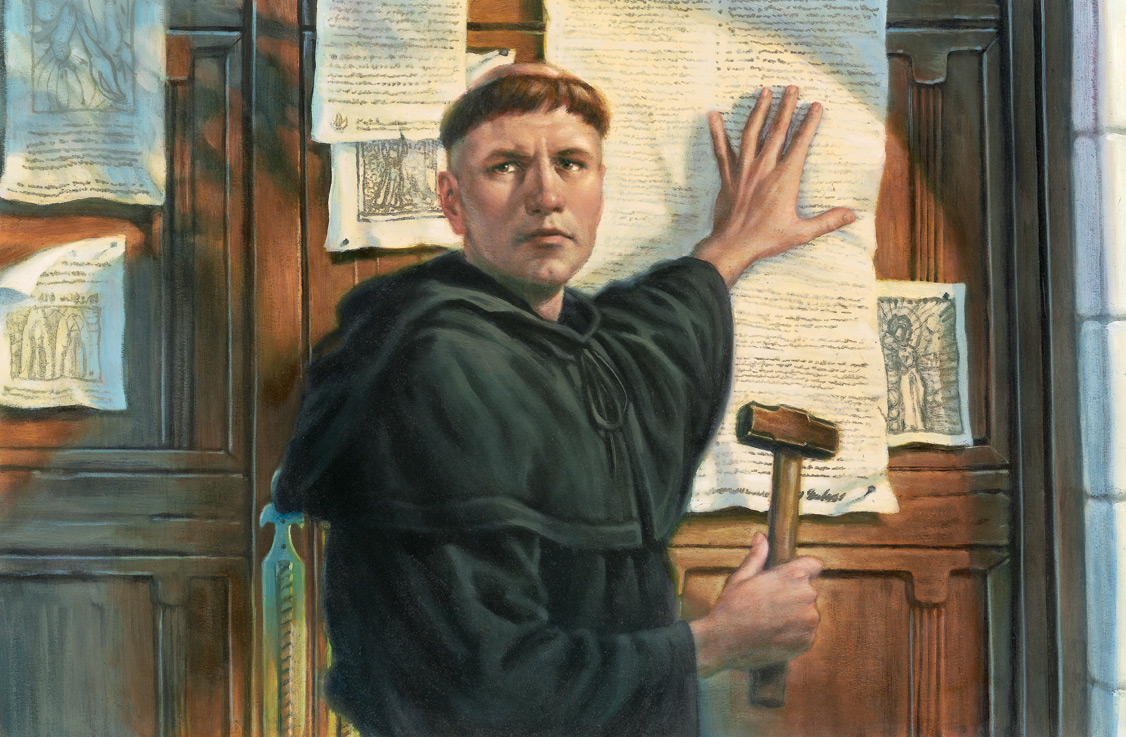
See the source image

The year was 1517, and a man named Martin Luther was not happy about the direction the church was going. To him, he saw the church as less religious and faith based and even became a political enemy filled with corruption. On top of that, the church sold indulgences for about half a years wages, which was around 3 Marx back in the day. Martin Luther didn’t understand how and why the church would do such a thing to these poor people. This led him to create his 95 Theses to the church and nail it on their front door

At the time, Christian lifestyle standards and liberties were up for debate. This was understood as Christian Liberty, put by Martin Luther. One of Luther’s most famous quotes was regarding Christian Liberty, “In essentials unity, in non-essentials liberty, and in all things charity.” Martin Luther was trying to say that charity and love should always be included in our interactions with others. Also, God gave us essentials, and room for non-essentials, such as food, music, art, jewelry, profession, the list goes on. But God says as long as we do not violate his essentials with our non-essentials, we have Christian Liberty to do or not to do.

I believe Luther’s ideas were right and just. He wanted the people to be able to read the Bible for themselves and he felt like the church was beginning to become too authoritative. He brought up good questions that stirred the pot and led to a separation of the church. I do not think Martin Luther wanted war or violence, he just wanted the church to change their corrupt ways. In releasing the 95 theses and writing the Bible in German, he began to make people think for themselves but it eventually led in violence. Martin Luther was a good man with a great heart sent from God, I just think he simply did not think far into the future about how people would react.

Benedictine Monks Extra Credit

See the source image

Living as or with Benedictine monks may seem crazy in 2020 due to our hectic non-stop lifestyles and our everyday distractions. Many of us think if we don’t pay attention to the news or the apps on our phone we will miss out on the important things going on in life. This perceived by many, is not true, and in 2005, BBC invited 5 men to live with Benedictine monks for 6 weeks to prove this statement wrong and open their eyes to the peace of silence.

As Catholics and even as lay people, we can learn a lot from the Benedictine monks. Living in silence, obedience, and humility has shown to strengthen their spiritual relationships and bring answers to that dissatisfaction in life.

The Benedictines teach that even if you are very advanced and experienced at something it is always good to be open to growth and new information with a humbling attitude. This helps you get better at all things and to be a well rounded induvial. Always staying committed to something that you have already started help us get through the hard times of life with persistence.

The Benedictines also teach us to never stop trying to improve our spiritual life. No matter how close we think we are with God, we can always inch closer. As well as staying optimistic to any ways of getting closer to God, including becoming a monk or joining the consecrated life. Lastly, obedience to our superiors and others will help us listen and learn new things we didn’t know existed.

I wish I had the same opportunity that the 5 men did during their time at the monastery. I think it would of been a good getaway from my daily life and would of been a true time to get closer to God in peace and silence. In my junior and senior year of high school I had a similar experience on a 3 day retreat called Kairos. During these 3 days we went through a lot of prayer and active thought. All phones and sense of time was taken away and afterword’s I felt renewed and overjoyed with God’s presence.

The 5 men that had the chance to experience this 6 week adventure with the Benedictine monastery were very lucky. Sticking with 2 men, Tony and Nicholas both left with a stronger relationship with God. Tony is currently in the porn industry, filming commercials specifically, and we all know how far away from God that industry is. At the start Tony did not believe in God and really didn’t see the point of the monastery. At the end he increased his faith, he did not yet fully believe in God but he definitely felt him and heard him speak to him. This was a huge step in the right direction of living a faithful life. Nicholas on the hand, went to church often and was on a spiritual search for 10 years. Even though he went to church he didn’t really believe what he was doing and he wanted to put the heart back into it. After the 6 weeks Nicholas felt renewed and filled with God’s love and joy.

What I took out of these 5 men’s journey with the Benedictine monks living in silence, obedience, and humility is that God is always with us, just sometimes when we don’t feel his presence we need to slow down, clear our distractions, and listen.

Design a site like this with WordPress.com
Get started